AI Live Sim

By clicking Subscribe you're confirming that you agree with our Terms and Conditions.
Which AI Defense and Security Applications Are Emerging?
Key Points
The Evolution of AI-Driven Intelligence Gathering
Autonomous Defense Systems in Combat Operations
Next-Generation Cybersecurity: AI as Digital Defender
Command Decision Support: From Data to Battlefield Advantage
Smart Logistics Applications
Regulatory Frameworks for Military AI Deployment
Ethical Considerations in Autonomous Defense Technologies
Did you know
Parting Shot
Article
Which AI Defense and Security Applications Are Emerging?

July 15, 2025 • 14 min read


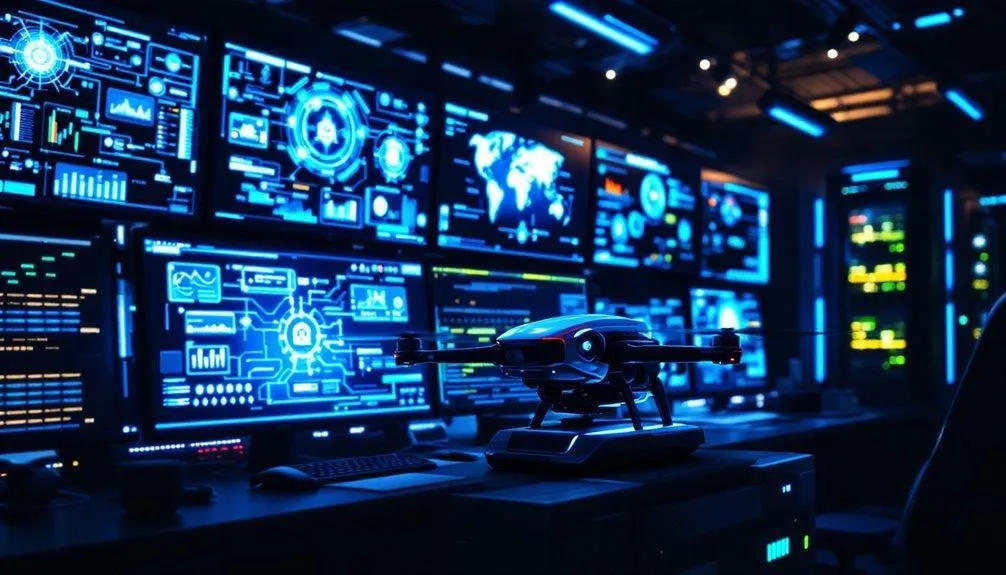
Key Points
- ● AI-driven intelligence systems process vast datasets with over 96% accuracy in threat detection, compressing intelligence cycles to minutes.
- ● Autonomous defense platforms perform reconnaissance, logistics, and precision strikes with minimal human oversight through systems like AMORPHOUS.
- ● Next-generation cybersecurity uses AI to scan networks, detect anomalies, and employ user behavior analytics to identify insider threats.
- ● Command decision support systems accelerate the OODA loop by fusing multisource data and providing predictive modeling of enemy actions.
- ● AI-powered logistics enhance military readiness through supply chain optimization, minimizing equipment downtime.
The Evolution of AI-Driven Intelligence Gathering

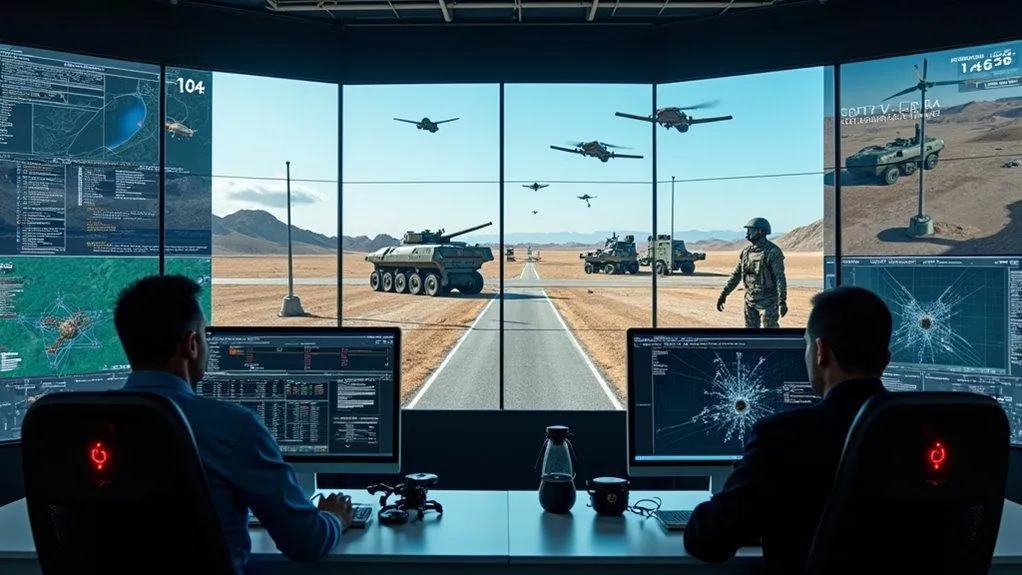
Autonomous Defense Systems in Combat Operations
| System Type | Primary Function | Key Advantage |
|---|---|---|
| UAVs | Surveillance & Strikes | Reduced risk to personnel |
| Ground Robots | Combat & Supply | Operation in hazardous zones |
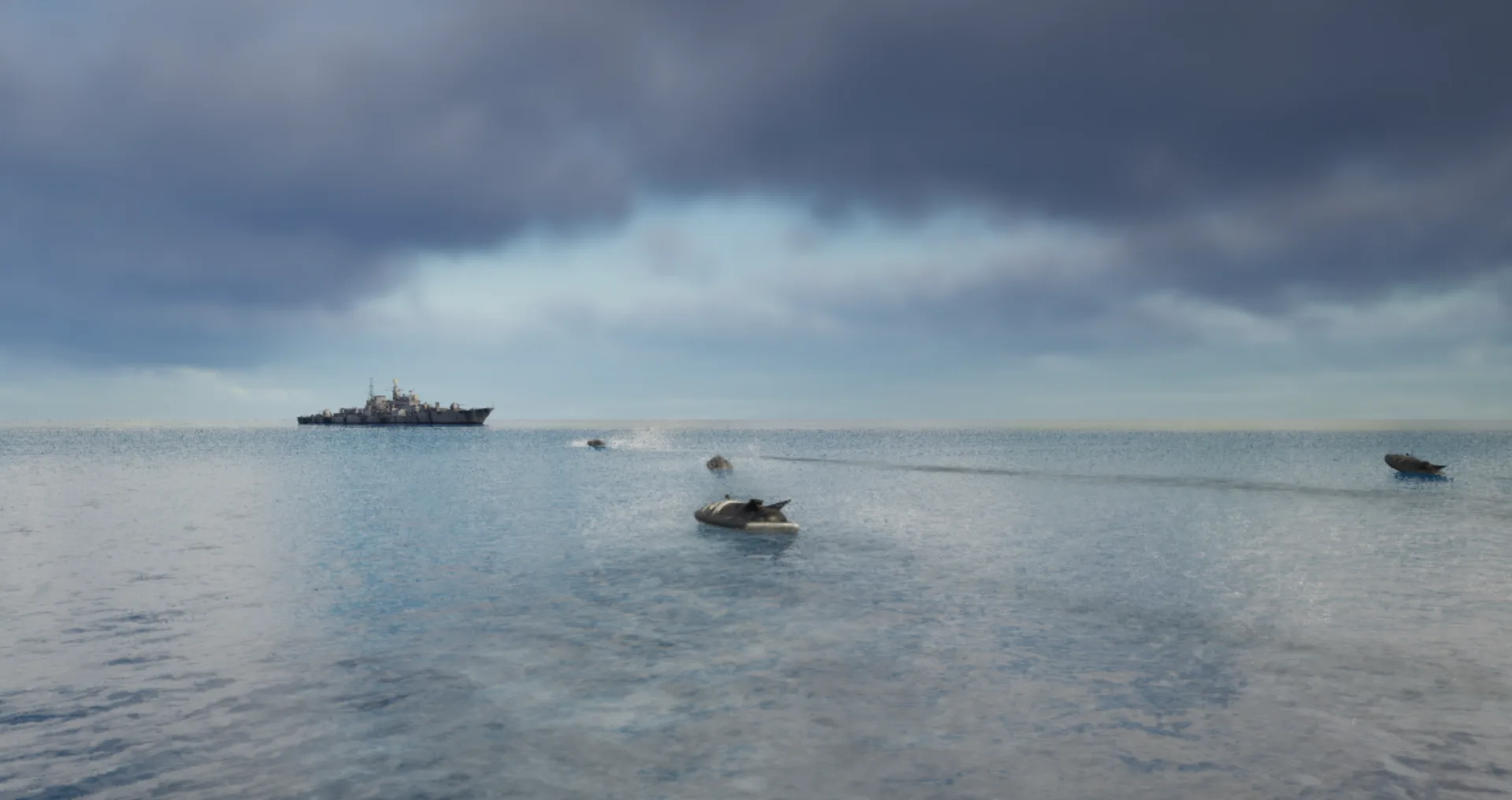
| Naval Drones | Maritime Patrol | Extended mission duration |
| Swarm Systems | Overwhelming Force | Distributed attack capability |
| Command AI | Decision Support | Accelerated response time |
Emergency Response and Disaster Management Applications
Beyond traditional combat operations, AI-powered autonomous systems are revolutionizing emergency response and disaster management capabilities for military and civilian applications. These systems utilize predictive modeling to analyze weather data and identify regions at high risk for natural disasters, enabling preemptive military deployment to critical zones before catastrophic events occur.
AI-assisted drones conduct real-time damage assessment and search-and-rescue operations in hazardous post-disaster environments, while machine learning algorithms optimize evacuation routes and resource distribution during emergency responses.
Following recent natural disasters, military units have successfully adapted battlefield AI technologies for civilian applications, demonstrating the versatility of these systems in tracking infrastructure damage, monitoring road closures, and coordinating relief efforts across multiple agencies simultaneously.
Multi-domain coordination allows these systems to operate seamlessly across land, air, sea, and cyber domains, while advanced algorithms enable split-second tactical decisions that outpace human capabilities.
Next-Generation Cybersecurity: AI as Digital Defender

Transforming digital defense landscapes, AI has emerged as the vanguard of next-generation cybersecurity frameworks. These systems scan massive volumes of network data to identify anomalies that traditional security measures might miss, effectively catching sophisticated threats before they cause damage.
AI-powered security operations centers are witnessing transformative changes through automation. Agentic AI works alongside human analysts, performing alert triage and threat research semi-autonomously while filtering thousands of alerts to reduce false positives. This collaboration allows security teams to focus on high-priority threats rather than routine monitoring tasks. User behavior analytics systems detect unusual activity patterns that may indicate compromised credentials or insider threats. Advanced threat prioritization enables pre-emptive defense strategies through intelligent pattern recognition. The integration of AI tools provides critical defense against ransomware attacks , which continue to represent one of the most significant threats to business operations today.
As the market for AI-based cybersecurity solutions approaches $115 billion by 2030, organizations are increasingly integrating these tools into their security stacks. These adaptive defense systems continuously learn from data, improving detection accuracy while reducing response time, creating a more responsive and predictive security posture against evolving digital threats.
Comprehensive AI Testing and Validation Frameworks
The reliability of AI defense systems depends heavily on rigorous testing protocols that simulate real-world attack scenarios and environmental challenges. Military organizations now employ comprehensive AI testing frameworks that include adversarial examples, stress testing against simulated massive cyber assaults, and validation through historical attack databases to ensure systems can distinguish between genuine threats and false positives.
These testing environments deliberately introduce sensor failures, weather-related disruptions, and equipment anomalies to verify AI systems maintain operational effectiveness under adverse conditions. Advanced testing protocols also incorporate mock intelligence reports containing subtle threat indicators, measuring how effectively AI platforms extract actionable insights while maintaining accuracy rates above 90% even when processing thousands of simultaneous data streams during crisis scenarios.
Command Decision Support: From Data to Battlefield Advantage

While AI fortifies digital infrastructure against cyber threats, its application extends directly to the battlefield through advanced command decision support systems. These systems dramatically accelerate the OODA loop—observe, orient, decide, act—giving commanders a critical tempo advantage over adversaries.
By fusing multisource data from drones, satellites, and sensors, AI creates comprehensive battlespace awareness that human analysis alone cannot match. The technology excels at predictive modeling, anticipating enemy actions by analyzing historical patterns and current movements, thereby enabling proactive rather than reactive tactics. AI outputs include critical assessments and recommendations for various military actions that influence strategic and tactical decisions. Modern combat operations increasingly leverage autonomous swarms that execute specific tasks based on objectives defined by soldiers while maintaining appropriate limitations.
Importantly, these systems maintain human-machine teaming principles, where AI supports but doesn’t replace human judgment. These collaborations employ User Centered Machine Learning approaches that improve tools through direct warfighter feedback.
Commanders retain oversight on critical decisions while benefiting from AI’s ability to rapidly process complex scenarios, identify ideal alternatives, and allocate resources efficiently—turning data superiority into battlefield advantage.
Smart Logistics Applications
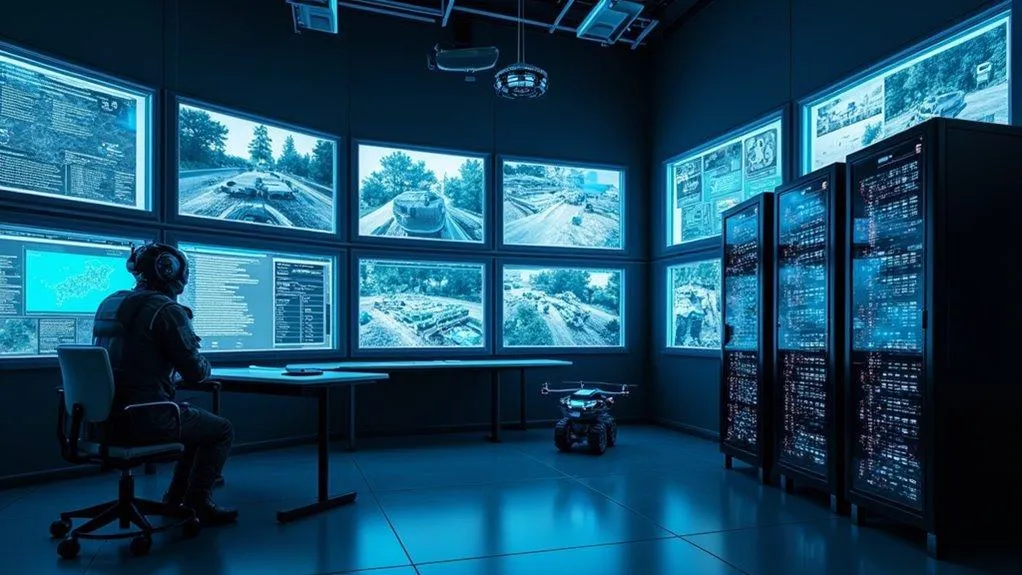
The sustainment backbone of modern defense operations lies in AI-powered smart logistics systems that transform military readiness. Defense organizations now utilize autonomous drone networks and supply chain optimization algorithms to coordinate complex resource movements, reducing operational bottlenecks by significant margins while enhancing mission effectiveness across multiple theaters.
AI algorithms process real-time data from transportation routes, inventory systems, and distribution networks to automate resource allocation and respond rapidly to changing battlefield conditions.
Three key benefits of AI-driven military logistics:
- Autonomous drone logistics networks that use advanced algorithms for route planning and real-time threat avoidance during supply missions
- Supply chain optimization systems that predict bottlenecks and automate resource allocation through machine learning analysis
- Enhanced operational coordination through AI simulation models that create detailed virtual environments mirroring real-world conditions
These innovations enable commanders to maintain operational tempo with fewer resources while advancing mission agility.
Regulatory Frameworks for Military AI Deployment

Military AI deployment is increasingly governed by international standards like the Political Declaration on Responsible Military Use of AI, which establishes ethical boundaries for autonomous systems in defense applications.
These frameworks mandate rigorous compliance with the five Responsible AI Tenets—requiring systems to be responsible, equitable, traceable, reliable, and governablethroughout their operational lifecycle.
The U.S. has further reinforced these standards through executive orders, DoD strategies, and implementation frameworks that defense contractors must follow when developing AI solutions for military applications.
International Deployment Standards
As global deployment of military AI systems accelerates, international regulatory frameworks have emerged to establish necessary guardrails for these powerful technologies. While no single comprehensive global regulation exists, several initiatives provide structure, including NATO’s six core principles and the UN-led REAIM initiative.
International deployment standards consistently emphasize three critical requirements:
- Human Control – Systems must maintain meaningful human oversight, with operators retaining override capabilities to disable autonomous functions.
- Traceability – AI decision-making processes require comprehensive logging systems to guarantee accountability.
- Certification Processes – Multidisciplinary teams of legal, military, and technical experts verify compliance with international humanitarian law.
These standards reflect growing recognition that commercial AI’s rapid integration into military applications necessitates clear guidelines.
The upcoming International AI Standards Summit 2025 promises further refinement of these frameworks as nations navigate this complex technological frontier.
Ethical Use Boundaries
Beyond international deployment standards, regulatory frameworks governing military AI applications have evolved into a complex mosaic of national, regional, and multilateral approaches. This patchwork creates inconsistent implementation challenges as technologies outpace rulemaking.
The United States employs executive orders and export controls targeting dual-use AI models, while the EU debates outright bans on lethal autonomous weapons. Certification standards remain fragmented, though NATO is developing military AI verification protocols similar to ammunition safety requirements.
Export controls represent another critical boundary, with the U.S. “AI Diffusion Rule” requiring licensing for specific AI model weights and hardware. The Wassenaar Arrangement classifies neural network management software as controlled items.
These evolving frameworks reflect the tension between innovation and ethical considerations, particularly regarding human control over autonomous lethal systems.
Ethical Considerations in Autonomous Defense Technologies

The ethical implications of autonomous defense technologies have emerged as a paramount concern in the rapidly evolving landscape of military AI applications. As nations develop increasingly sophisticated autonomous systems, balancing technological capability with moral responsibility presents significant challenges for military planners, engineers, and policymakers alike.
Key ethical considerations include:
Ethical deployment of autonomous defense technologies requires robust human oversight, clear accountability, and unwavering adherence to humanitarian principles.
- Human oversight remains essential – the “human in the loop” paradigm guarantees that critical decisions about lethal force remain under meaningful human control, preserving moral judgment in warfare.
- Accountability frameworks must address the “responsibility gap” – establishing clear chains of responsibility when autonomous systems make decisions or malfunction.
- Systems must comply with International Humanitarian Law – autonomous technologies need verifiable mechanisms to distinguish between combatants and civilians while meeting proportionality requirements.
Interested in synthetic data for your project? AILiveSim 2.0 (our new version!) enhances AI-based simulation for multi-sensor autonomous systems - automating data generation, analysis, and augmentation to streamline model training and testing. Find out more: (https://ailivesim.com).
Did you know
How Are Soldiers Being Trained to Work Alongside AI Systems?
What Countermeasures Exist Against Adversarial AI Defense Technologies?
Countermeasures against adversarial AI technologies include robust model design, continuous monitoring systems, input preprocessing techniques, attack surface reduction strategies, and cross-organizational information sharing to identify and neutralize emerging threats systematically.
How Does AI Affect Military Recruitment and Workforce Composition?
Defense forces are experiencing a talent evolution as AI transforms recruitment priorities, drawing digital natives while reshuffling traditional personnel requirements. Technological aptitude increasingly trumps physical prowess, reshaping military workforce demographics toward technical specialization.
What Contingency Plans Exist for AI System Failures?
Organizations implement contingency plans including emergency shutdown mechanisms, sandboxed environments, backup systems, anomaly detection, and detailed recovery protocols to guarantee business continuity when AI systems fail or behave unpredictably.
How Do Weather Conditions Impact AI Defense System Performance?
Through AI-driven simulation training, defense systems overcome weather-related challenges by practicing navigation through synthetic storm environments, learning to distinguish genuine targets from weather-induced decoys in fog and rain, and developing adaptive algorithms that maintain sensor fusion capabilities when individual sensors fail.
These simulated training environments prepare autonomous drones for real-world deployment in harsh conditions, while battlefield recognition software trains extensively on snow and dust storm scenarios to ensure reliable target identification. Enhanced AI-based simulations reduce risks during actual operations by allowing systems to experience thousands of weather scenarios virtually before deployment.
Parting Shot
Resources
Explore Our Latest Insights
Stay informed with our expert articles and updates.
Article
Have You Tested Enough? Intelligent System Testing and the Coverage Problem
Test volume measures effort, not proof. How Intelligent System Testing samples scenarios adaptively to map where an autonomous system works, where it fails, and which combination of conditions moves it from one to the other.

AILiveSim
August 22, 2026 • 4 min read
Article
Swarm Defense Testing: Measuring Intercepts, Not Detections
Why no volume of captured data validates swarm defense: adversarial scenarios generated live around the system under test, scored as intercepts achieved versus hits on the protected vessel across repeatable, parameterizable waves.
AILiveSim
August 17, 2026 • 4 min read

Article
Counter-Drone Detection: Why Precision Fails Before Recall Does
Why counter-drone detection fails on precision before recall: negative-class coverage by sensor channel, and scoring threats neutralized alongside friendlies preserved on repeatable, configurable drone waves.
AILiveSim
August 13, 2026 • 4 min read

Article
What Has to Be Inside an Airport Digital Twin Before It Is Worth Anything
What an airport digital twin must contain before it is worth anything: rare surface conditions, four time-aligned sensors, automatic labelling, and procedural generation that extends to your airport.
AILiveSim
August 10, 2026 • 4 min read


Discover the benefits of synthetic data and simulation
By navigating on this site you agree that we use only minimal cookies required for this site to function. We do not monetize your data.