AI Live Sim

By clicking Subscribe you're confirming that you agree with our Terms and Conditions.
Counter-Drone Detection: Why Precision Fails Before Recall Does
The Model Improved. It Still Called a Tree Branch a Drone.
Your Detector Is Only as Precise as the Things It Learned to Ignore
When Twenty Tracks Are Inbound and Some of Them Are Yours
The Gap Opens at the Sensor, not at the Geometry
Score Friendlies Preserved, Not Threats Detected
Rewrite the Targeting Logic, Then Run the Same Wave Again
“Our Scenarios Are Classified”
$54.6 Billion Is Moving, and the Evidence Bar Moves With It
Get Started with the Counter-Drone Starter Pack
Article
Counter-Drone Detection: Why Precision Fails Before Recall Does

August 13, 2026 • 4 min read


AILiveSim Counter-Drone Starter Pack
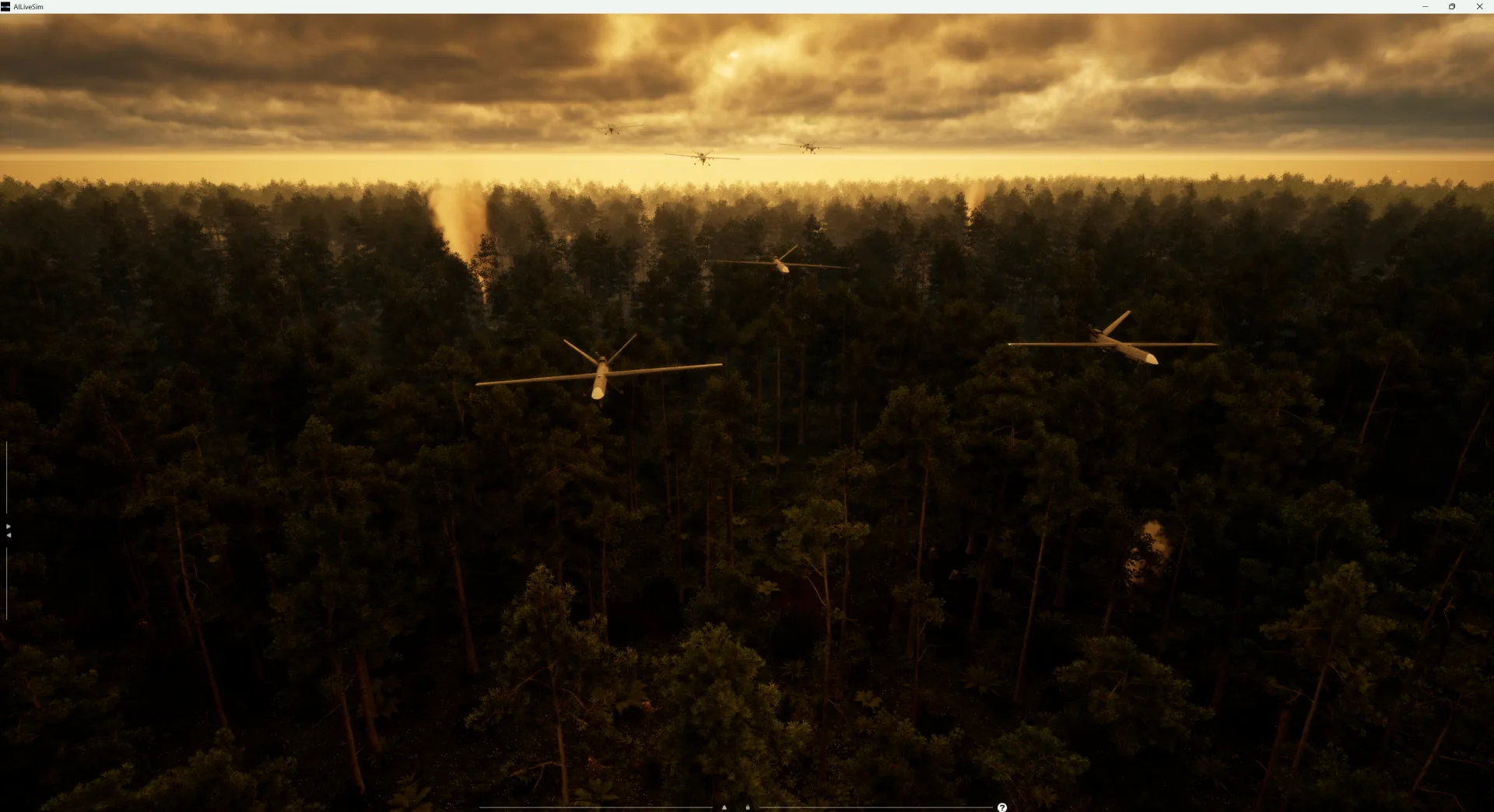
A counter-drone engagement in the AILiveSim Counter-Drone Starter Pack
The Model Improved. It Still Called a Tree Branch a Drone.
A published experiment set out to measure how much synthetic data helps drone detection. Adding synthetic imagery to a real dataset raised prediction confidence by roughly 18% and improved intersection over union by roughly 60%, with the largest gains in dark scenes the real dataset had under-represented. A good result, and a clear one.
The same team then reported what had not improved. Tree branches and rock fragments were still being classified as drones.
That residual usually gets filed under edge cases and left there. It is not an edge case. It is a precise description of what the model was never shown enough of.
Your Detector Is Only as Precise as the Things It Learned to Ignore
NVIDIA reports that developers building physical artificial intelligence systems need between 10,000 and 100,000 training clips per task before real-world performance becomes reliable. That figure comes from robotics rather than counter-uncrewed aerial systems work, but it scales the problem honestly, and the important word in it is per.
A counter-drone system does not have one class. It has the thing it is hunting, and everything in the sky that resembles it at the ranges and conditions where resemblance peaks. What causes the confusion differs by sensor channel.
- Visible camera. Birds at several hundred meters, kites, distant balloons, and branch movement at the edge of frame.
- Thermal. Rotor heat against a warm background at dusk, or a bird whose body temperature reads close enough at range.
- Radar. Small radar cross-section returns from clutter that a filter tuned for sensitivity will happily pass through.
None of that is capturable on a schedule. All of it sets your precision ceiling. Worth asking your own team: do you know your false-positive rate by condition, or only in aggregate?
When Twenty Tracks Are Inbound and Some of Them Are Yours
MarketIntelo forecasts the military drone-swarm systems market rising from $3.7 billion in 2025 to roughly $20.1 billion by 2034, a figure listed with its source in our 2026 statistics review. The practical counter to a swarm is generally another swarm, so hostile and friendly object counts climb together.
A false-positive rate that is tolerable against a single intruder becomes an operational problem when twenty tracks are inbound and some of them belong to you. At that point precision stops being a model metric and becomes a question about what your system does to friendly assets.
The Gap Opens at the Sensor, not at the Geometry
Across a month of public engineering discussion on social media and technical forums, our internal research found that the most technically engaged threads on simulation transfer traced failure to interface behavior rather than to physics accuracy. Teams described policies that behaved correctly in simulation and then failed on hardware for reasons that had nothing to do with the model: bus latency, thread timing, sensor drift.
Applied to counter-drone work, the equivalent is a detector validated on clean synthetic imagery meeting a real sensor with real noise, a real thermal gradient, and real clutter. That is where the gap opens. It is also why the fidelity of the sensor model matters more to your result than the fidelity of the scene behind it.
Score Friendlies Preserved, Not Threats Detected
Most counter-uncrewed aerial systems evaluation reports detection rate. Detection rate improves when a system becomes more willing to call anything a drone, which is the behavior you are trying to prevent.
The Counter-Drone Starter Pack scores three things together instead:
- Threats neutralized
- Friendlies preserved
- Waves failed
Two of those get worse when a system becomes trigger-happy and measuring them alongside each other is the whole point. A change that lifts your neutralization count while quietly dropping friendlies preserved is visible on the leaderboard immediately, rather than in an after-action review.
Because the waves are configurable, you can run the same engagement twice. Change the detection model, the aiming logic, or the target-selection rule, run the identical wave again, and the difference in score belongs to that change. That is attribution rather than impression, and it is what turns a simulation into a benchmark.
Rewrite the Targeting Logic, Then Run the Same Wave Again
The pack ships with one landscape plugin and one drone plugin, preconfigured scenarios you can run on the first day, and a step-by-step guide for building drone-labelling scenarios so your team can extend past what comes in the box.
The working pattern is simple. Run the baseline. Rewrite one part of the system, whether that is detection, aiming, targeting, or firing logic. Run the same wave again. Post the score. Four weeks, thirty hours of simulation, unlimited editing time, fixed price.
Engineering teams tend to like this pack more than they expect to, because it behaves like a benchmark they can compete against rather than a demonstration they have to sit through.
“Our Scenarios Are Classified”
Three objections come up more than any others.
- Our scenarios are classified. The pack runs locally or in your cloud, so the scenarios you build stay in the environment you choose.
- We already have a range. Range gives you a small number of expensive engagements in whatever weather you got that week. This gives you the same engagement repeatedly under conditions you set.
- Thirty hours is not much. It is sized to answer one question, which is whether repeatable scoring surfaces a precision problem your current process does not.
$54.6 Billion Is Moving, and the Evidence Bar Moves With It
Two numbers set the commercial context. MarketsandMarkets projects the counter-drone market to pass $10 billion by 2030 at more than 25% annual growth. The United States Department of Defense requested $54.6 billion for autonomous warfare in fiscal 2027, its largest drone and counter-drone commitment on record. The market projection and the budget request are both listed, with their sources, in our 2026 statistics review.
Procurement at that pace raises the bar on how quickly a supplier can evidence system behavior under conditions a customer names rather than conditions the supplier chose. The Counter-Drone Starter Pack is live now on the AILiveSim website. Enroll there or get in touch if you want to talk through which pack fits.
Get Started with the Counter-Drone Starter Pack
Run your own detection, aiming, targeting, and firing logic against configurable drone waves, and score threats neutralized alongside friendlies preserved so a gain in one is never hidden by a loss in the other.
Four weeks, thirty hours of simulation, unlimited editing time, fixed price. One landscape plugin, one drone plugin, scenarios you can run on the first day, and a guide for building your own drone-labelling scenarios once you want to go further.
See the full scope, what is included, and how to enroll on the Counter-Drone Starter Pack page.
Resources
Explore Our Latest Insights
Stay informed with our expert articles and updates.
Article
Have You Tested Enough? Intelligent System Testing and the Coverage Problem
Test volume measures effort, not proof. How Intelligent System Testing samples scenarios adaptively to map where an autonomous system works, where it fails, and which combination of conditions moves it from one to the other.
AILiveSim
August 22, 2026 • 4 min read

Article
Swarm Defense Testing: Measuring Intercepts, Not Detections
Why no volume of captured data validates swarm defense: adversarial scenarios generated live around the system under test, scored as intercepts achieved versus hits on the protected vessel across repeatable, parameterizable waves.
AILiveSim
August 17, 2026 • 4 min read

Article
What Has to Be Inside an Airport Digital Twin Before It Is Worth Anything
What an airport digital twin must contain before it is worth anything: rare surface conditions, four time-aligned sensors, automatic labelling, and procedural generation that extends to your airport.
AILiveSim
August 10, 2026 • 4 min read
Article
Generative AI builds the 3D asset; physics-based simulation produces the sensor data. Retrain detection models on a changing target before new real data exists.
AILiveSim
August 4, 2026 • 5 min read

Discover the benefits of synthetic data and simulation
By navigating on this site you agree that we use only minimal cookies required for this site to function. We do not monetize your data.