AI Live Sim

By clicking Subscribe you're confirming that you agree with our Terms and Conditions.
Swarm Defense Testing: Measuring Intercepts, Not Detections
You Cannot Launch a Hostile Swarm at Your Own Carrier
Three Kinds of Edge Case, and Only One Is a Data Problem
Change the Targeting Logic and the Whole Engagement Changes Shape
Intercepts Achieved Versus Hits on the Vessel You Are Protecting
Start With Ground Truth, Finish with Your Own Detector
“It Will Never Match a Real Adversary”
Half the Surface Fleet Uncrewed, and a Safety Code Already in Force
Four Weeks to Know Whether Your Defensive Logic Holds
Get Started with the Interceptor USV Starter Pack
Article
Swarm Defense Testing: Measuring Intercepts, Not Detections

August 17, 2026 • 4 min read


AILiveSim Interceptor USV & UAV Starter Pack
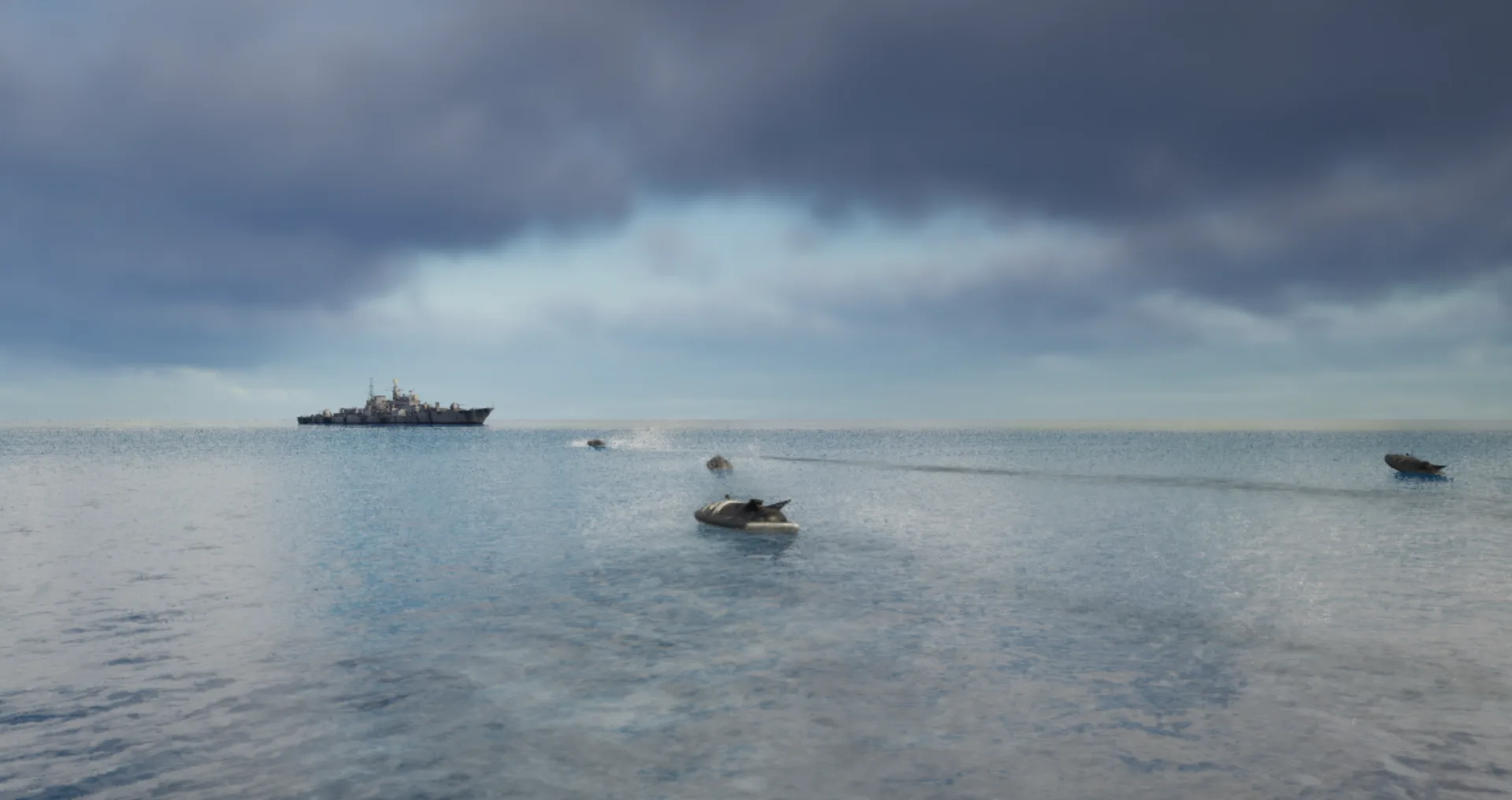
A swarm-defense engagement in the AILiveSim Interceptor USV & UAV Starter Pack
You Cannot Launch a Hostile Swarm at Your Own Carrier
Hostile uncrewed surface vessel swarms are a planning assumption for navies operating anywhere contested, and the teams building defensive stacks against them share a problem with no field solution.
You cannot launch a swarm of hostile vessels at your own carrier to find out whether your detection and intercept logic holds. No version of that trial is safe, affordable, or repeatable, and repeatable is the one that matters most, because a test you can run once tells you what happened rather than whether you improved.
Three Kinds of Edge Case, and Only One Is a Data Problem
Across a month of public engineering discussion on social media and technical forums, our internal research found rare-event coverage was the single highest-volume topic in autonomous systems development, ahead of every other difficulty we tracked. Almost all of it gets discussed as one problem. It is three.
| Kind of edge case | Example | Can it be captured? |
|---|---|---|
| Rare but natural | Heavy sea state, low light, sensor degradation | Slowly and expensively, but you can wait for it |
| Dangerous or destructive | Collision, loss of platform, live intercept | Once, at high cost, and not repeatably |
| Adversarial and reactive | Swarm approach, evasion, coordinated attack | Not at all, because the scenario responds to your system |
Only the first is a data problem. The second is a budget problem. The third is neither, and it is the one this pack exists for.
Change the Targeting Logic and the Whole Engagement Changes Shape
A recorded dataset holds what happened once. In an intercept, the approach a swarm takes depends on where your interceptors go, which depends on what your detection stack saw a moment earlier. Change the target-selection rule and the entire engagement changes shape around it.
That is why no volume of captured data validates swarm defense. The scenario must be generated live, around the system under test.
It is worth being clear about what this does and does not claim. The purpose is not to predict how a specific adversary will behave. It is to hold a set of approach profiles constant while your system changes, so that a difference in outcome can be attributed to the change you made.
Intercepts Achieved Versus Hits on the Vessel You Are Protecting
The pack includes a pre-built Protect the VIP scenario: a defended military vessel, an attacking uncrewed surface vessel swarm on configurable approach splines, and a friendly intercepting swarm. A wave is one coordinated approach, and wave count, speed, and difficulty are all parameterizable, so you can build the engagement your mission actually anticipates.
What comes back is not a detection score. It is intercepts achieved versus hits on the protected vessel.
That is the difference between a component metric and an operational one. A detection accuracy figure tells a programme manager very little on its own. Eleven intercepts and one hit tells them something they can act on. Run the same wave again after changing your target-selection logic, return seven intercepts and three hits, and you have learned that the change was wrong, with no argument about whether the comparison was fair.
Start With Ground Truth, Finish with Your Own Detector
The sample runs camera-only, and that is a deliberate starting point rather than a limitation. You begin from ground-truth bounding boxes, driving interceptor heading and velocity commands from target positions, which lets you prove the intercept behavior before your detector is in the loop confusing two problems at once. Once the control logic holds, you bring your own detector in.
The stack underneath is built for automatic identification system data, radar, laser scanning, and camera fusion. The scenario you validate against in the pack is the one your deployment configuration can run against later, which matters because our research found transfer failures cluster at the sensor and interface layer rather than in the physics.
“It Will Never Match a Real Adversary”
Three objections come up more than any others.
- Simulated swarm behavior will never match a real adversary. It does not need to. It needs to stay constant while your system changes, which is what makes the comparison mean anything.
- Our scenarios are classified. The pack runs locally or in your cloud, so the scenarios you build stay in the environment you choose.
- Camera-only is not our deployment configuration. It is the starting configuration, and the fusion path is why the work carries forward instead of being repeated.
Half the Surface Fleet Uncrewed, and a Safety Code Already in Force
At the end of week four you hold a ready-made scenario for testing detection and interception logic, thirty hours of simulation, unlimited editing time, a fixed price agreed before you start, and mission-level scoring you can put in front of someone who has to sign.
The context around it is moving quickly. In December 2025 the United States Navy awarded a $392 million production contract for a single unmanned surface-vessel programme, part of a stated goal to make half its surface fleet uncrewed. Separately, the MASS Code, the first international safety framework for autonomous ships, has been in force since 1 July 2026, and because it is goal-based it asks operators to demonstrate auditable evidence of safe behavior rather than work through a prescriptive checklist. The contract award and the entry into force of the MASS Code are both listed, with their sources, in our 2026 statistics review.
Programs on that timeline need defensive logic evidenced well before there is a hull available to test it on.
Four Weeks to Know Whether Your Defensive Logic Holds
The Interceptor USV and UAV Starter Pack is live now on the AILiveSim website. Enroll there or get in touch if you want to talk through which pack fits your programme.
Get Started with the Interceptor USV Starter Pack
Put a working swarm-defense testbed inside your own developer environment, run the Protect the VIP scenario against waves you parameterize, and measure intercepts achieved against hits on the vessel you are protecting.
Four weeks, thirty hours of simulation, unlimited editing time, fixed price. Start from ground-truth bounding boxes to prove your intercept behavior, then bring in your own detector once the control logic holds.
See the full scope, what is included, and how to enroll on the Interceptor USV Starter Pack page.
Resources
Explore Our Latest Insights
Stay informed with our expert articles and updates.
Article
Have You Tested Enough? Intelligent System Testing and the Coverage Problem
Test volume measures effort, not proof. How Intelligent System Testing samples scenarios adaptively to map where an autonomous system works, where it fails, and which combination of conditions moves it from one to the other.
AILiveSim
August 22, 2026 • 4 min read
Article
Counter-Drone Detection: Why Precision Fails Before Recall Does
Why counter-drone detection fails on precision before recall: negative-class coverage by sensor channel, and scoring threats neutralized alongside friendlies preserved on repeatable, configurable drone waves.
AILiveSim
August 13, 2026 • 4 min read

Article
What Has to Be Inside an Airport Digital Twin Before It Is Worth Anything
What an airport digital twin must contain before it is worth anything: rare surface conditions, four time-aligned sensors, automatic labelling, and procedural generation that extends to your airport.
AILiveSim
August 10, 2026 • 4 min read
Article
Generative AI builds the 3D asset; physics-based simulation produces the sensor data. Retrain detection models on a changing target before new real data exists.
AILiveSim
August 4, 2026 • 5 min read

Discover the benefits of synthetic data and simulation
By navigating on this site you agree that we use only minimal cookies required for this site to function. We do not monetize your data.