AI Live Sim

By clicking Subscribe you're confirming that you agree with our Terms and Conditions.
AI Simulation, Synthetic Data & Autonomous Systems: Statistics, Facts & Trends 2026
Key Takeaways
AI Simulation, Digital Twins & Simulation-in-the-Loop
Synthetic Data
Autonomous Vehicles & the Validation Problem
Sensors & Multi-Sensor Perception
Drones, Defense & Military Autonomy
Maritime, Aviation & Industrial Autonomy
AI, Synthetic Data & the Software Development Lifecycle
Physical AI & Embodied Autonomy
Drone Swarms & Coordinated Autonomy
Facts About AI Simulation & Autonomous Systems
2026 Trends
Frequently Asked Questions
Sources & Methodology
How to Cite This Page
Article
AI Simulation, Synthetic Data & Autonomous Systems: Statistics, Facts & Trends 2026

July 15, 2026 • 12 min read


Last updated: July 2026
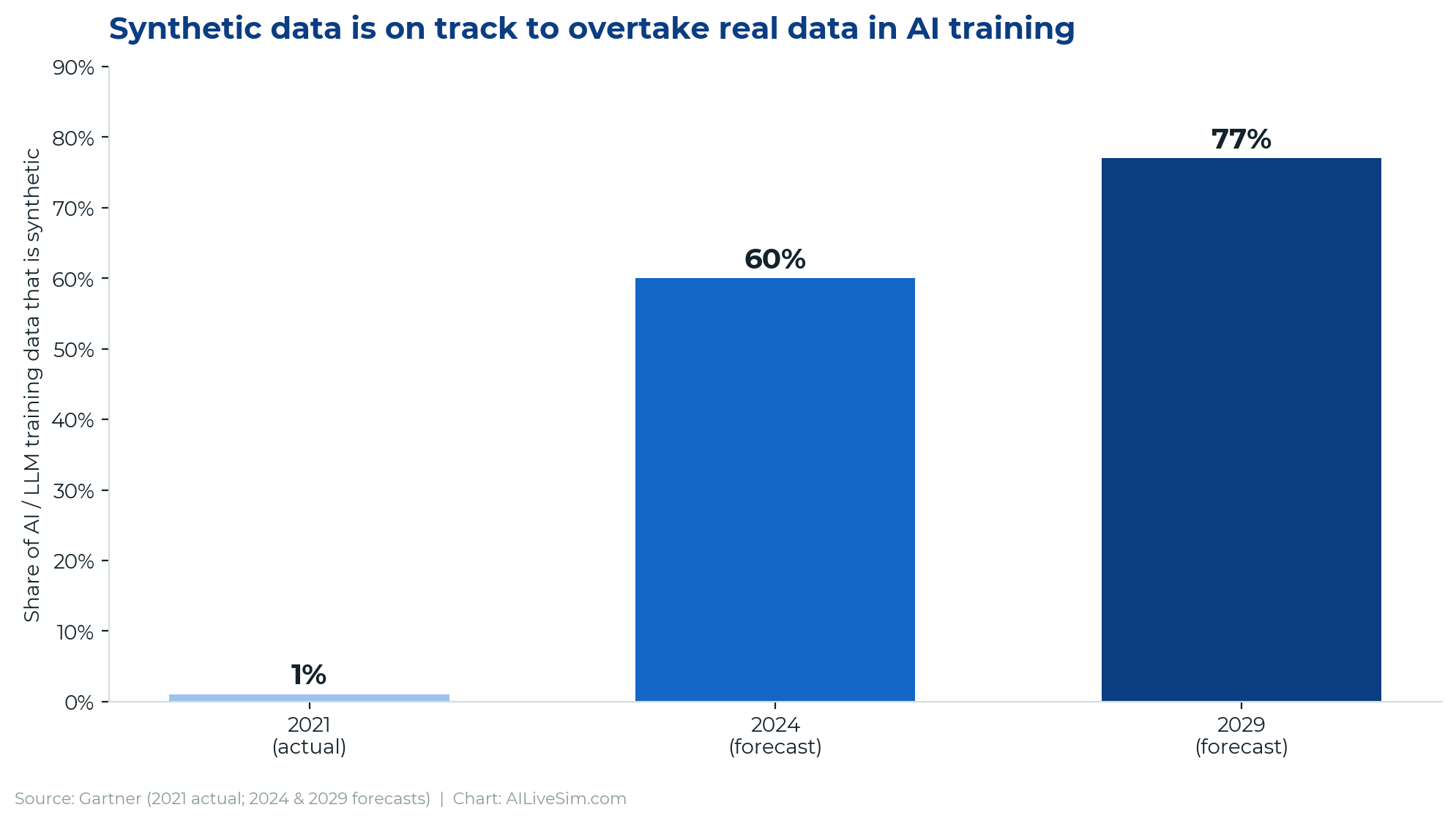
Autonomy is moving from the lab to the real world faster than physical testing can validate it, and the gap is being closed with simulation and synthetic data. This page compiles 63 verified, individually quotable statistics, plus key facts and the defining trends shaping AI simulation, synthetic data, multi-sensor perception, software development, physical AI, and autonomous systems across automotive, maritime, aviation, defense, and industry. The single number that frames the shift: 77% of the data used to train large AI models will be synthetic by 2029, up from just 4% in 2025. Every figure below is free to reference with a link back to this page.
Source: Gartner. Chart by AILiveSim.
Key Takeaways
- 77% of large-model AI training data will be synthetic by 2029, up from 4% in 2025. (Gartner)
- It would take roughly 11 billion miles of driving to prove an autonomous vehicle is safer than a human. (RAND)
- The leading robotaxi fleet has driven nearly 200 million real autonomous miles, and billions more in simulation, with 92% fewer injury claims than human drivers. (Waymo / Swiss Re)
- Gartner projects 60% of all new code will be AI-generated by the end of 2026. (Gartner)
- The humanoid-robot market could reach $38 billion by 2035 (Goldman Sachs); the wider embodied-AI market $5 trillion by 2050 (Morgan Stanley).
- The U.S. Pentagon requested $54.6 billion for autonomous warfare in fiscal 2027; world military spend hit a record $2.72 trillion in 2024. (U.S. DoD; SIPRI)
- The military drone-swarm market is forecast to reach about $20 billion by 2034. (MarketIntelo)
- The IMO adopted the first-ever global safety code for autonomous ships, in force since 1 July 2026. (IMO)
AI Simulation, Digital Twins & Simulation-in-the-Loop
Source: Grand View, Yole, Mordor, MarketsandMarkets. Chart by AILiveSim.
- Global AI spending is forecast to reach $1.8 trillion in 2025 and $4.7 trillion by 2029, a 33% CAGR. (Gartner, 2025)
- Within that forecast, AI-ready data is the fastest-growing segment, projected to grow at a 155% CAGR. (Gartner, 2025)
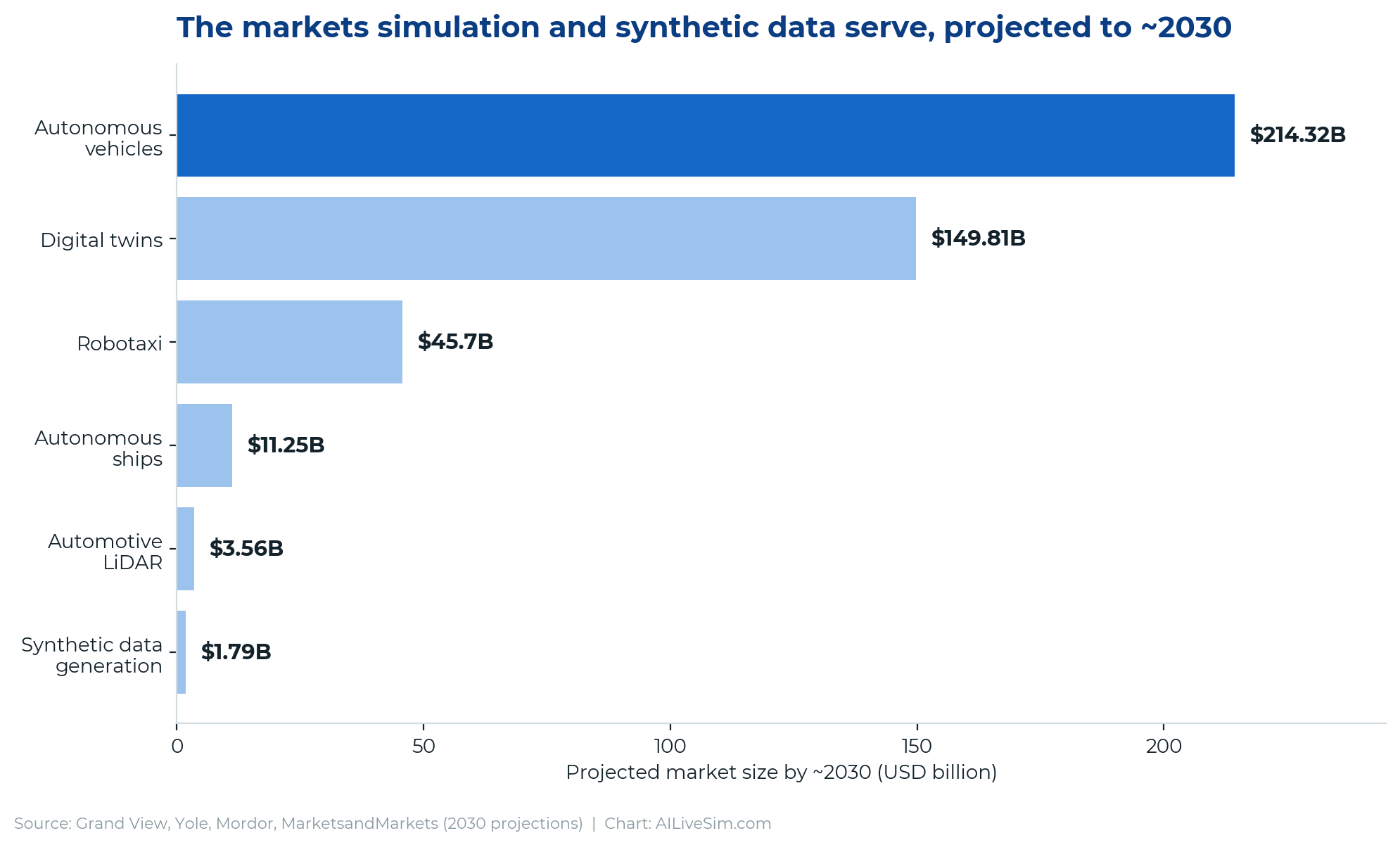
- The global digital twin market is projected to grow from $21.14 billion in 2025 to $149.81 billion by 2030 (47.9% CAGR). (MarketsandMarkets, 2025)
- Europe’s digital twin market is forecast to rise from $7.08 billion in 2025 to $49.32 billion by 2030. (MarketsandMarkets, 2025)
- 88% of organizations now report using AI in at least one business function, up from 78% a year earlier. (McKinsey, 2025)
Simulation, digital twins, and synthetic data are converging into a single “simulation-in-the-loop” discipline: the virtual environment sits inside the AI development, training, and validation cycle rather than beside it.
Synthetic Data
- 77% of the data used to train large language models will be synthetic by 2029, up from 4% in 2025. (Gartner, 2025)
- As recently as 2021, only 1% of all AI training data was synthetic; Gartner forecast that share would reach 60% by 2024. (Gartner, 2021)
- The global synthetic data generation market was valued at $218.4 million in 2023 and is projected to reach $1,788.1 million by 2030 (35.3% CAGR). (Grand View Research, 2023)
- Europe accounted for 26.7% of the global synthetic data generation market in 2023, worth $58.2 million. (Grand View Research, 2023)
- By 2027, 60% of data and analytics leaders are expected to face critical failures in managing synthetic data. (Gartner, 2025)
- The global data annotation and labeling market, the manual work synthetic data replaces, is worth roughly $3.6 billion in 2025, heading for $17.1 billion by 2034. (Dataintelo, 2025)
- Automatic labeling that leverages synthetic data can cut project timelines by up to 60%, particularly in autonomous-vehicle training. (Technavio, 2026)
Real-world data is slow and expensive to collect and under-represents the rare, high-risk “long-tail” events where AI models fail. Synthetic data arrives perfectly labeled and can be generated on demand for scenarios that are dangerous or impossible to capture in reality.
Autonomous Vehicles & the Validation Problem
Source: RAND Corporation; Waymo. Chart by AILiveSim.
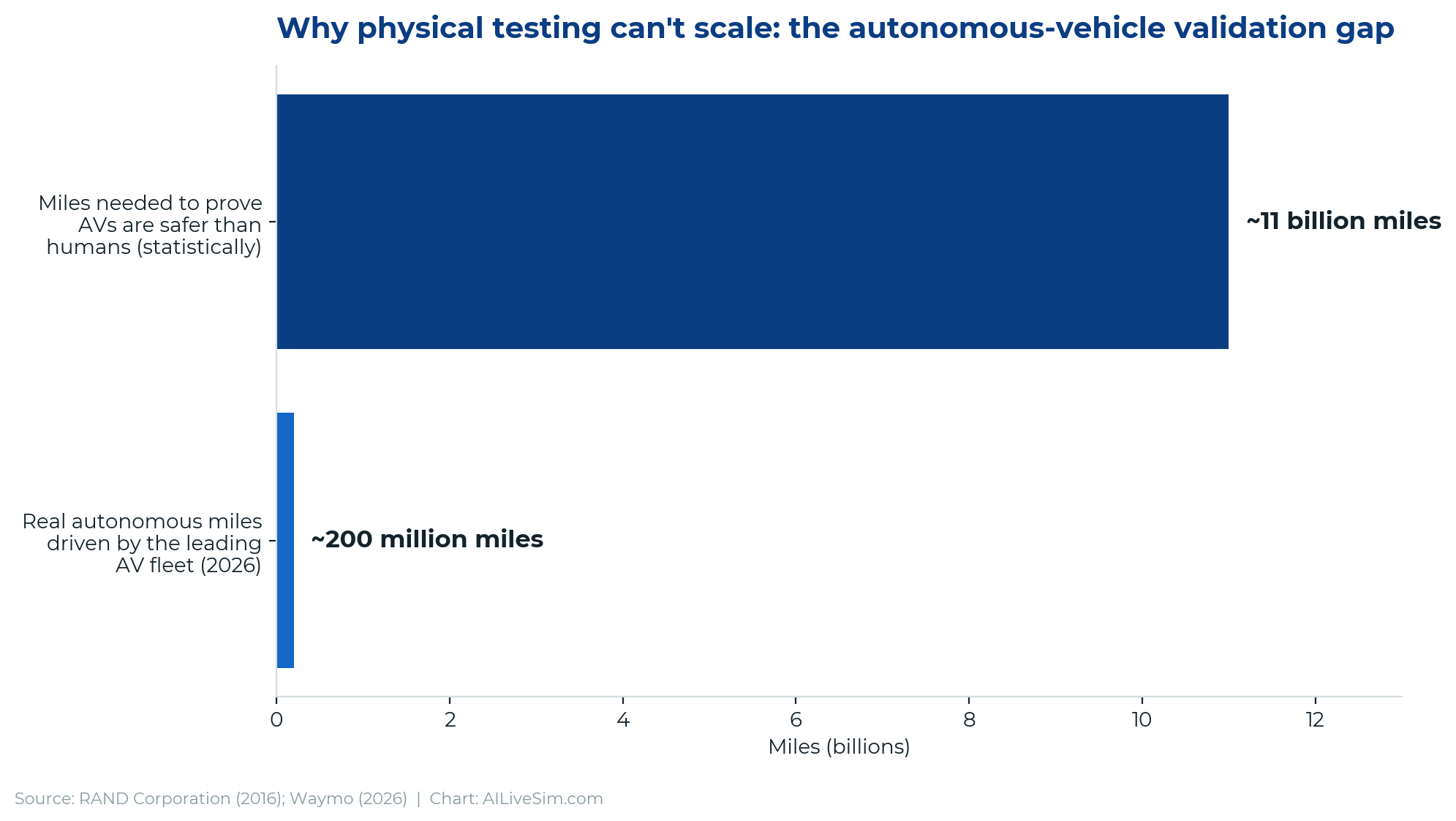
- Autonomous vehicles would need roughly 11 billion miles of driving to statistically demonstrate they are safer than human drivers, a bar that is impractical to reach through physical testing alone. (RAND Corporation, 2016)
- The leading autonomous-driving developer has logged nearly 200 million real autonomous miles and billions more in simulation. (Waymo, 2026)
- At peak, as many as 25,000 virtual vehicles run up to 10 million simulated miles per day for a single developer. (Waymo, 2021)
- Over a comparable set of miles, the leading robotaxi fleet recorded 92% fewer bodily-injury insurance claims than human drivers, among the first insurer-grade evidence that AVs can be safer than people. (Swiss Re / Waymo, 2024)
- That same fleet now provides 450,000+ paid autonomous rides per week and has surpassed 127 million fully driverless miles. (Swiss Re / Waymo, 2026)
- A single hour of autonomous-vehicle test-drive data can require hundreds of annotator-hours to label accurately. (Dataintelo, 2026)
- The global autonomous vehicle market was estimated at $68.09 billion in 2024 and is projected to reach $214.32 billion by 2030 (19.9% CAGR). (Grand View Research, 2024)
- The commercial robotaxi fleet is forecast to grow from roughly 7,000 vehicles in 2025 to about 1 million in 2030 and 6 million by 2035. (Goldman Sachs, 2026)
- Robotaxis are projected to become a $415 billion market by 2035, within an autonomous-vehicle sector that could reach $2 trillion in annual revenue. (Goldman Sachs, 2026)
- The projected cost per mile for an autonomous truck could fall from $6.15 in 2025 to $1.89 in 2030, economics that depend on validating the system first. (Goldman Sachs, 2026)
You cannot drive your way to a safety proof. Every leading developer pairs a small number of real miles with orders of magnitude more in simulation, and the first insurer-grade safety results are now arriving, giving regulators a validation bar that favours simulation-based evidence.
Sensors & Multi-Sensor Perception
- The global automotive LiDAR market grew to $859 million in 2024 and is projected to quadruple to $3.56 billion by 2030 (24% CAGR). (Yole Group, 2024)
- More than 1.6 million automotive LiDAR units shipped in 2024, more than double the prior year, across over 120 vehicle models. (Yole Group, 2024)
- The total LiDAR market across all applications is projected to grow from $3.27 billion in 2025 to $12.79 billion by 2030. (MarketsandMarkets, 2025)
- A high-autonomy vehicle’s sensor suite can generate up to 19 terabytes of data per hour; even lower-autonomy systems produce around 1.4 terabytes per hour. (Siemens, 2026)
- A single 128-beam LiDAR sensor produces over 2.6 million 3D points per second, and advanced vehicles carry several. (arXiv, 2025)
- Chinese suppliers accounted for 93% of the passenger-car LiDAR market in 2024. (Yole Group, 2024)
Perception is a multi-sensor problem, camera, radar, LiDAR, and thermal fused together, and each sensor multiplies the data a system must process, label, and validate. Sensor-realistic simulation generates perfectly labeled multi-sensor data on demand and lets teams compare combined versus individual sensor performance.
Drones, Defense & Military Autonomy
Source: U.S. Department of Defense. Chart by AILiveSim.
- World military expenditure reached a record $2.72 trillion in 2024, up 9.4%, the steepest rise since the Cold War. (SIPRI, 2024)
- NATO members accounted for 55% of world military spending in 2024 ($1,506 billion); the United States alone spent $997 billion, or 37% of the global total. (SIPRI, 2024)
- European military spending (including Russia) rose 17% to $693 billion in 2024, beyond the continent’s Cold War peak. (SIPRI, 2024)
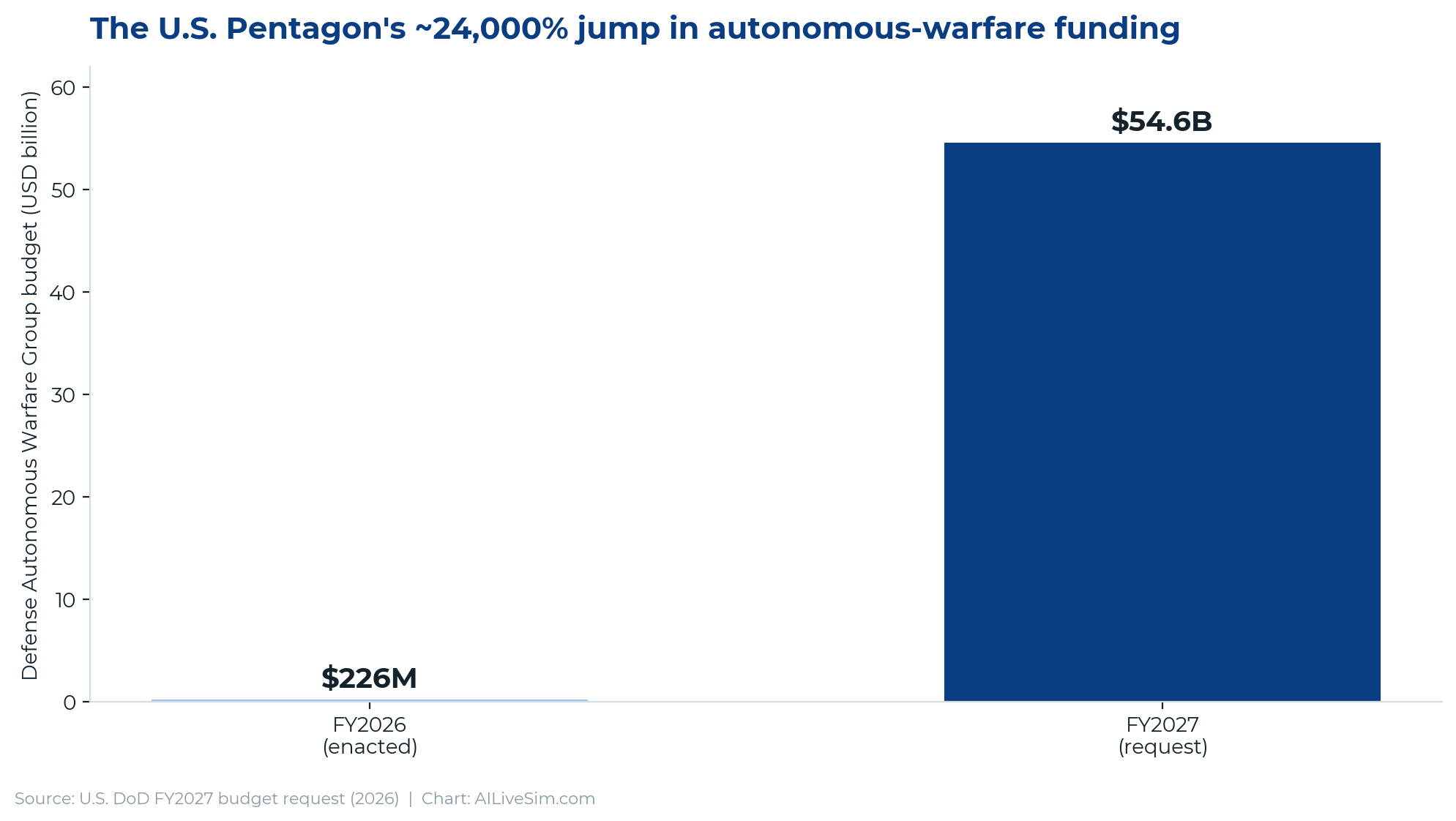
- The U.S. Pentagon requested $54.6 billion for its Defense Autonomous Warfare Group in fiscal 2027, the largest single investment in drone and counter-drone technology in U.S. history. (U.S. DoD, 2026)
- The Department of Defense budgeted $25.2 billion for AI and autonomous-systems programs in fiscal 2025, about 3% of its $850 billion budget. (U.S. DoD, 2025)
- The Pentagon’s Replicator initiative set out to field thousands of low-cost, attritable autonomous systems across air, land, sea, and space. (Congressional Research Service, 2025)
- The global military simulation and virtual training market was valued at $14.5 billion in 2024, heading for $17.9 billion by 2030. (Research and Markets, 2024)
- The U.S. Navy awarded a $392 million production contract for a single unmanned surface-vessel program in December 2025, part of a goal to make half its surface fleet uncrewed. (U.S. Navy, 2025)
The scenarios that matter most in defense, adversarial behavior, sensor denial, GPS jamming, contested environments, are the ones that are dangerous, cost-prohibitive, or impossible to stage live. Commanders and certifiers need defensible, auditable coverage that is achievable only in simulation.
Maritime, Aviation & Industrial Autonomy
- The IMO adopted the first-ever global safety code for Maritime Autonomous Surface Ships (the MASS Code) in May 2026; it took effect on 1 July 2026. (IMO, 2026)
- The global autonomous ships market was recorded at $6.96 billion in 2025 and is forecast to reach $11.25 billion by 2030. (Mordor Intelligence, 2025)
- Partially autonomous vessels held 74.35% of the market in 2024, while fully autonomous vessels are the fastest-growing segment (19.58% CAGR). (Mordor Intelligence, 2024)
- The number of industrial robots in operational use worldwide reached 4,664,000 units in 2024, a 9% increase and an all-time high. (International Federation of Robotics, 2024)
- A record 542,000 industrial robots were installed in 2024, more than double a decade earlier, with Asia at 74% of new deployments. (International Federation of Robotics, 2024)
- China’s operational stock of industrial robots surpassed 2 million units in 2024, the largest of any country. (International Federation of Robotics, 2024)
- The global military aerospace simulation and training market is estimated at $1.43 billion in 2025. (Mordor Intelligence, 2025)
- Physical AI developers report needing 10,000 to 100,000 training clips per task to reach reliable real-world performance. (NVIDIA, 2026)
AILiveSim’s core verticals, maritime, aviation, and mobile machines, are converging on the same requirement: proving a system is safe across the full operational design domain before it touches the real world.
AI, Synthetic Data & the Software Development Lifecycle
- Gartner projects that 60% of all new code written globally will be AI-generated by the end of 2026. (Gartner, 2026)
- Gartner expects 90% of enterprise software engineers to use AI coding assistants by 2028, up from under 14% in early 2024. (Gartner, 2025)
- 84% of developers now use or plan to use AI tools, up from 76% a year earlier, and 51% use them daily. (Stack Overflow Developer Survey, 2025)
- GitHub Copilot generates an average of 46% of the code its users write (61% for Java) and is deployed at 90% of Fortune 100 companies. (GitHub / Microsoft, 2025)
- Roughly 25% of new code at Google is now AI-generated, according to the company. (Google, 2025)
- The AI code-tools market grew from about $4.9 billion in 2024 toward a projected $26 billion-plus by the early 2030s. (MarketsandMarkets / industry, 2024)
- Data teams still spend roughly 45% of their time on data preparation and cleaning, the bottleneck that synthetic, pre-labeled “data on demand” is built to remove. (Anaconda State of Data Science, 2023)
The same shift is coming to how autonomy software is built and validated. As AI writes more of the code, the binding constraint moves to data, the labeled, edge-case-rich examples needed to train and test models. Synthetic data turns that scarce input into something a team can generate on demand rather than wait months to collect.
Physical AI & Embodied Autonomy
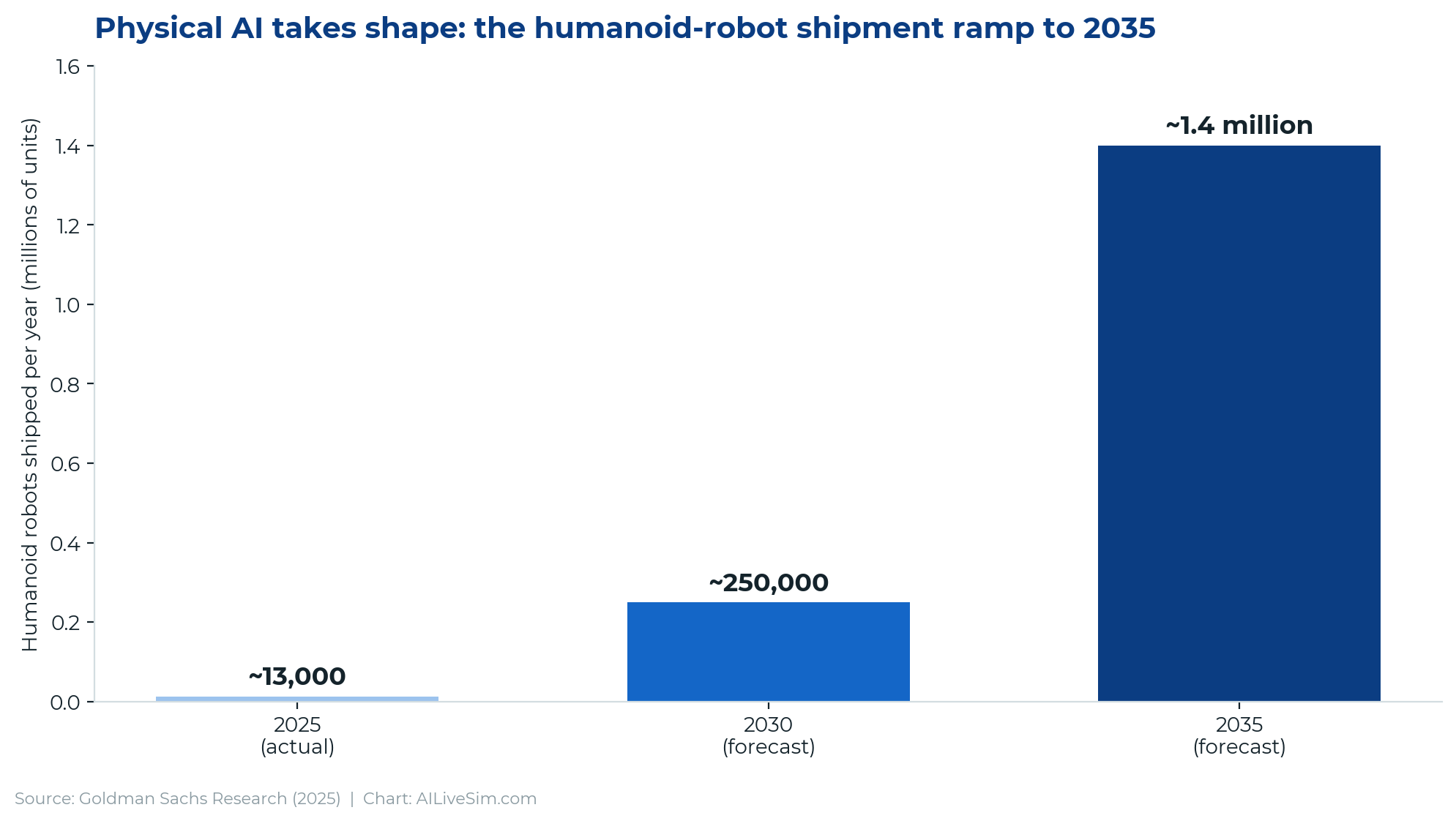
Source: Goldman Sachs Research. Chart by AILiveSim.
- Goldman Sachs projects the humanoid-robot market will reach $38 billion by 2035, a sixfold upward revision from its earlier $6 billion estimate, with about 1.4 million units shipped. (Goldman Sachs, 2025)
- Goldman Sachs expects 250,000+ humanoid units shipped annually by 2030, as manufacturing cost per unit has already fallen about 40% to $30,000 to $150,000. (Goldman Sachs, 2025)
- Morgan Stanley forecasts a $5 trillion humanoid and embodied-AI market by 2050, scaling to roughly 1 billion humanoids in service. (Morgan Stanley, 2025)
- Morgan Stanley projects around 13 million humanoids in service by 2035. (Morgan Stanley, 2025)
- Humanoid-robotics startups raised more than $3.2 billion in 2025 alone, exceeding the combined total of the previous 14 years. (Dealroom / analyst compilation, 2025)
- Analyst forecasts for the 2035 humanoid market span $9 billion to $251 billion across 20+ research firms, underscoring how early and uncertain the category is. (Dealroom / analyst compilation, 2026)
Physical AI, intelligence embodied in machines that perceive and act, is the category AILiveSim is built for. These systems can’t learn from scraped internet text; they need real-world-grounded and synthetic sensor data, generated in simulation, to develop and prove their behaviour safely.
Drone Swarms & Coordinated Autonomy
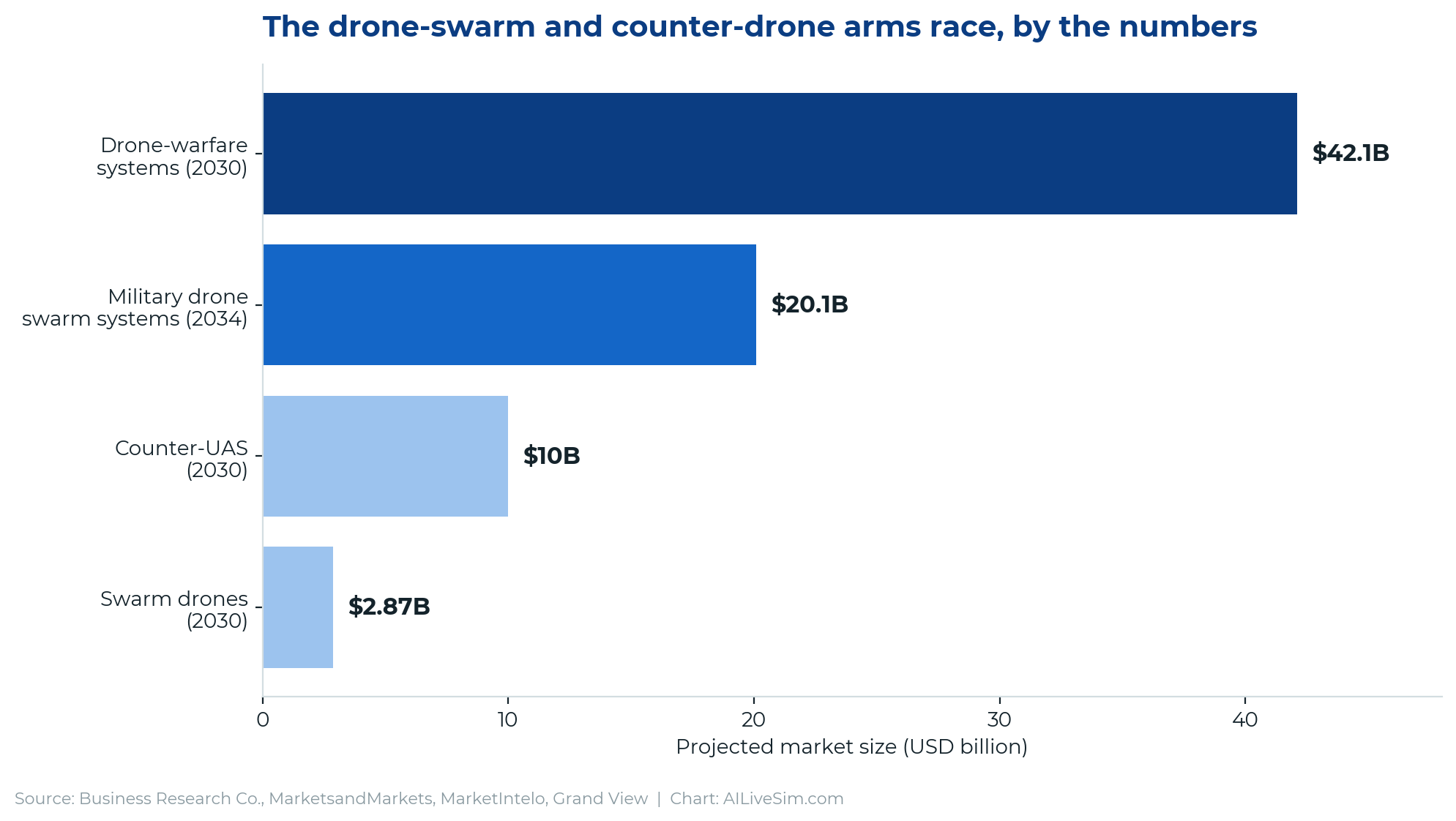
Source: Business Research Co., MarketsandMarkets, MarketIntelo, Grand View. Chart by AILiveSim.
- The swarm-drones market is projected to grow from about $1 billion in 2025 to $2.87 billion by 2030 (23.5% CAGR). (The Business Research Company, 2025)
- The broader military drone-swarm systems market is forecast to rise from $3.7 billion in 2025 to roughly $20.1 billion by 2034. (MarketIntelo, 2025)
- North America held 42.6% of the military drone-swarm market in 2025 (~$1.58 billion), driven by the DoD’s Replicator, DARPA’s OFFSET, and the U.S. Navy’s LOCUST swarm programs. (MarketIntelo, 2025)
- The U.S. Air Force’s Collaborative Combat Aircraft program is expected to inject $6 billion-plus into the autonomous-wingman and swarm ecosystem through 2030. (MarketIntelo, 2025)
- The counter-drone (C-UAS) market is projected to exceed $10 billion by 2030, growing more than 25% a year. (MarketsandMarkets, 2025)
- The wider drone-warfare-systems market could reach about $42 billion by 2030. (Grand View Research, 2025)
A drone swarm is a coordination problem that cannot be safely or affordably iterated by flying thousands of real aircraft. Swarm behaviours and their counter-measures are developed and stress-tested in simulation, running many virtual engagements to train the AI before a single sortie, which is exactly the infrastructure AILiveSim builds for defense autonomy.
Facts About AI Simulation & Autonomous Systems
Fact 1. The IMO’s MASS Code is the world’s first international safety framework for commercial autonomous ships, defining four degrees of autonomy from decision-support to fully crewless. (IMO, 2026)
Fact 2. China holds the world’s largest operational fleet of industrial robots, the first country to surpass 2 million units in service. (International Federation of Robotics, 2024)
Fact 3. The United States is the world’s largest military spender, at $997 billion in 2024, roughly 3.2 times the next-largest spender. (SIPRI, 2024)
Fact 4. RAND’s 2016 finding that autonomous vehicles cannot be “driven to safety” remains the most-cited justification for simulation-based validation. (RAND Corporation, 2016)
Fact 5. “Physical AI”, AI embodied in machines that perceive and act in the real world, became a defining industry category in 2026. (NVIDIA, 2026)
Fact 6. Waymo’s Swiss Re-verified safety record, 92% fewer bodily-injury claims than human drivers, is among the first large-scale, insurer-grade evidence that autonomous vehicles can be safer than people. (Swiss Re / Waymo, 2024)
Fact 7. Tesla has deployed more than 1,000 of its Optimus humanoid robots inside its own factories and is tooling to produce up to 1 million units per year. (Tesla / press, 2025)
Fact 8. Figure AI reached a $39 billion valuation in September 2025, raising over $1 billion, one of the most valuable robotics startups ever. (Figure AI / press, 2025)
Fact 9. China has committed more public capital to humanoid robots than all other nations combined, via a fund reported at roughly $138 billion. (Morgan Stanley / press, 2025)
Fact 10. The mandatory IMO MASS Code is targeted for adoption by 2030 and entry into force on 1 January 2032. (IMO, 2026)
2026 Trends
Eight forces are reshaping how autonomy is built and validated in 2026, and each one pulls simulation and synthetic data further into the core of the development cycle.
The rise of “Physical AI” and world models
Generative world foundation models now produce photorealistic, physics-aware synthetic environments on demand, letting developers amplify a small amount of real data into the diversity a robot or vehicle needs, shifting synthetic data from a supplement to a primary source. (NVIDIA)
AI writes the code; data becomes the moat
As AI generates the majority of new software, competitive advantage shifts from writing code to owning high-quality, edge-case-rich data. For autonomy teams, proprietary synthetic data becomes the defensible asset. (Gartner)
Synthetic data goes mainstream
The share of AI training data that is synthetic is projected to pass the majority mark before the end of the decade as real-world collection hits privacy, cost, and coverage limits. (Gartner)
The humanoid and embodied-AI race
Capital is flooding into physical AI, with U.S. and Chinese programs competing to put general-purpose robots into factories and homes, and every one of them needs simulation to learn safely before deployment. (Morgan Stanley)
Drone swarms and the counter-swarm arms race
Coordinated autonomy is reshaping defense, and because the most effective counter to a swarm is another swarm, offensive and defensive investment now rise together, all of it validated first in simulation. (MarketIntelo)
Defense autonomy drives the funding surge
Uncrewed systems have moved to the center of defense budgets, and because the highest-value scenarios are the hardest to stage live, the surge pulls simulation and synthetic-data validation with it. (SIPRI)
Regulation catches up with autonomy
The IMO’s first global MASS Code signals that autonomous systems now face formal, goal-based safety frameworks demanding demonstrable, auditable validation, which rewards simulation. (IMO)
Data on demand replaces data collection
Data-centric AI reframes the bottleneck from model design to data supply. Synthetic generation turns labeled training and test data into something teams switch on, rather than spend months collecting and annotating. (Anaconda State of Data Science)
Frequently Asked Questions
Quick answers to the questions we hear most about AI simulation, synthetic data, and autonomous systems.
What is synthetic data in AI?
Synthetic data is artificially generated data, images, sensor readings, or scenarios, created to train and test AI models instead of, or alongside, real-world data. It arrives perfectly labeled and can be produced on demand for rare or dangerous situations. Gartner projects 77% of large-model training data will be synthetic by 2029, up from 4% in 2025.
Why do autonomous vehicles need simulation?
Because physical testing cannot scale to a safety proof. RAND calculated that autonomous vehicles would need roughly 11 billion miles to statistically demonstrate they are safer than humans. Developers close that gap in simulation, the leading developer has driven nearly 200 million real miles but billions more virtually.
How much data does an autonomous vehicle generate?
A high-autonomy vehicle’s sensor suite can generate up to 19 terabytes of data per hour, and even lower-autonomy systems around 1.4 terabytes per hour, from cameras, radar, LiDAR, and other sensors. A single 128-beam LiDAR alone produces more than 2.6 million 3D points per second.
How is AI changing software development?
AI already generates a large share of new code, Gartner projects 60% of all new code will be AI-generated by the end of 2026, and 84% of developers use or plan to use AI tools. As AI writes more code, the bottleneck shifts to data, which is why synthetic, on-demand data is becoming central to building AI systems.
What is Physical AI?
Physical AI refers to AI embodied in machines, robots, drones, autonomous vehicles, that perceive and act in the real world. Unlike text-based AI trained on internet data, physical AI must learn from real-world-grounded and synthetic data. Goldman Sachs projects the humanoid-robot market alone will reach $38 billion by 2035.
What is a drone swarm and how is it developed?
A drone swarm is a group of drones that coordinate autonomously to act as one system. Because flying thousands of real drones to iterate on behavior is impractical, swarms and their counter-measures are trained and validated in simulation. The military drone-swarm systems market is forecast to reach about $20 billion by 2034.
How big is the autonomous systems market?
Estimates vary by segment: the autonomous vehicle market is projected to reach roughly $214 billion by 2030, digital twins about $150 billion, autonomous ships about $11 billion, robotaxis around $415 billion by 2035, and humanoid robots about $38 billion by 2035. Defense is a major driver, the U.S. requested $54.6 billion for autonomous warfare in fiscal 2027 alone.
What is the IMO MASS Code?
It is the world’s first international safety code for Maritime Autonomous Surface Ships, adopted by the IMO in May 2026 and in force since 1 July 2026. It sets a goal-based framework requiring autonomous ships to meet safety standards equivalent to conventional vessels, with a mandatory version targeted for 2032.
Sources & Methodology
Statistics are drawn from primary and authoritative sources published between mid-2024 and mid-2026, with a small number of clearly-labeled foundational references (e.g., RAND, 2016) retained for enduring relevance. Priority was given to official bodies (SIPRI, U.S. DoD, IMO, IFR), primary operator, bank, and research data (Waymo, RAND, Goldman Sachs, Morgan Stanley, Swiss Re, Gartner), and established market-research firms. Market-size projections vary between firms; where they do, we cite one authoritative source and note that estimates differ. Reviewed and refreshed annually.
- Gartner — Top Data & Analytics Predictions
- Grand View Research — Synthetic Data Generation Market
- Grand View Research — Synthetic Data Generation Market, Europe
- Grand View Research — Autonomous Vehicles Market
- RAND Corporation — Driving to Safety
- Waymo — The Waymo World Model
- Waymo — Simulation
- Goldman Sachs — Robotaxis
- Yole Group — Automotive LiDAR
- MarketsandMarkets — LiDAR
- MarketsandMarkets — Digital Twin
- Siemens — The Data Deluge
- arXiv — LiDAR Point Generation
- SIPRI — World Military Expenditure 2024
- U.S. DoD — Largest-Ever Drone Investment
- U.S. DoD Budget Analysis
- Congressional Research Service — Replicator
- Research and Markets — Military Simulation & Virtual Training
- IMO — MASS Code Adopted
- Mordor Intelligence — Autonomous Ships Market
- Mordor Intelligence — Military Aerospace Simulation & Training
- International Federation of Robotics — Global Robot Demand
- McKinsey — AI Adoption
- Dataintelo — Data Annotation & Labeling Market
- Technavio — Data Labeling & Annotation Tools
- NVIDIA — Cosmos Foundation Model for Physical AI
- U.S. Navy Contract Reporting — Autonomous Shipping
- Gartner — AI-Generated Code Statistics
- GitHub / Microsoft — Copilot Statistics
- Google — AI-Generated Code
- MarketsandMarkets / industry — AI Coding Assistants
- Anaconda — State of Data Science
- Goldman Sachs — Humanoid Robot Market
- Morgan Stanley — Humanoid Robot Market
- Dealroom / analyst compilation — Humanoid Forecasts
- Swiss Re / Waymo — Physical AI Safety Evidence
- The Business Research Company — Swarm Drones Market
- MarketIntelo — Military Drone-Swarm Systems Market
- MarketsandMarkets — Military Drone Market
- Grand View Research — Drone Warfare Market
How to Cite This Page
This research is free to cite and share with attribution. Please credit AILiveSim and link to this page.
AILiveSim (2026). AI Simulation, Synthetic Data & Autonomous Systems: Statistics, Facts & Trends 2026. Retrieved from https://ailivesim.com/articles/ai-simulation-synthetic-data-autonomous-systems-statistics-2026
Written by Michael Haralson, Head of Inbound. AILiveSim is a simulation-to-scale platform for AI simulation and synthetic data generation, building trustworthy autonomy for intelligent machines across maritime, defense, aeronautics, and mobile machines. Media inquiries and requests for comment or data: Emilie Cohen, Head of Marketing, emilie@ailivesim.com.
Resources
Explore Our Latest Insights
Stay informed with our expert articles and updates.
Article
Have You Tested Enough? Intelligent System Testing and the Coverage Problem
Test volume measures effort, not proof. How Intelligent System Testing samples scenarios adaptively to map where an autonomous system works, where it fails, and which combination of conditions moves it from one to the other.

AILiveSim
August 22, 2026 • 4 min read

Article
Swarm Defense Testing: Measuring Intercepts, Not Detections
Why no volume of captured data validates swarm defense: adversarial scenarios generated live around the system under test, scored as intercepts achieved versus hits on the protected vessel across repeatable, parameterizable waves.
AILiveSim
August 17, 2026 • 4 min read

Article
Counter-Drone Detection: Why Precision Fails Before Recall Does
Why counter-drone detection fails on precision before recall: negative-class coverage by sensor channel, and scoring threats neutralized alongside friendlies preserved on repeatable, configurable drone waves.
AILiveSim
August 13, 2026 • 4 min read

Article
What Has to Be Inside an Airport Digital Twin Before It Is Worth Anything
What an airport digital twin must contain before it is worth anything: rare surface conditions, four time-aligned sensors, automatic labelling, and procedural generation that extends to your airport.
AILiveSim
August 10, 2026 • 4 min read


Discover the benefits of synthetic data and simulation
By navigating on this site you agree that we use only minimal cookies required for this site to function. We do not monetize your data.