AI Live Sim

By clicking Subscribe you're confirming that you agree with our Terms and Conditions.
Procedural Airports: Build a Digital Twin of Any Airport for Synthetic Data and AI Testing
What a Procedural Airport Actually Is
Recreating Real Airports as Digital Twins
Simulate Any of the World’s Thousands of Airports
From a 2D Shape File to a 3D Landscape at Runtime
Control Over Every Parameter, Not a Fixed Level
Speed, Scale, and Control: The Customer Payoff
Conclusion
Article
Procedural Airports: Build a Digital Twin of Any Airport for Synthetic Data and AI Testing

August 4, 2026 • 5 min read


Most simulation work hits the same wall: you can only test against the environments someone took the time to build by hand. For teams training perception systems or testing autonomy around airfields, that usually means a few airports standing in for a world full of them.
AILiveSim takes a different route. Hand the platform a flat, two-dimensional description of an airport and it generates the full three-dimensional landscape for you.
Almost any airport can then become a place to produce synthetic data and put AI through its paces.
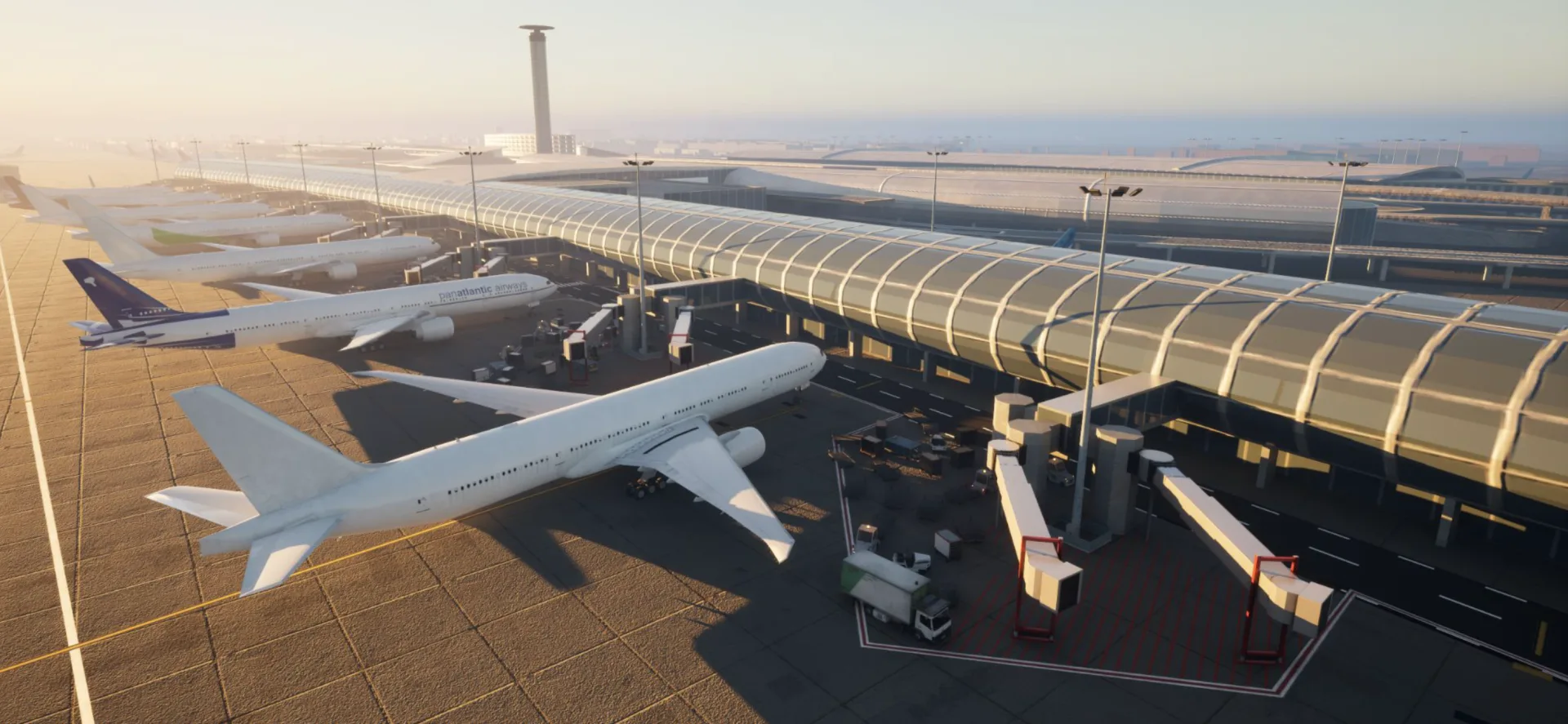
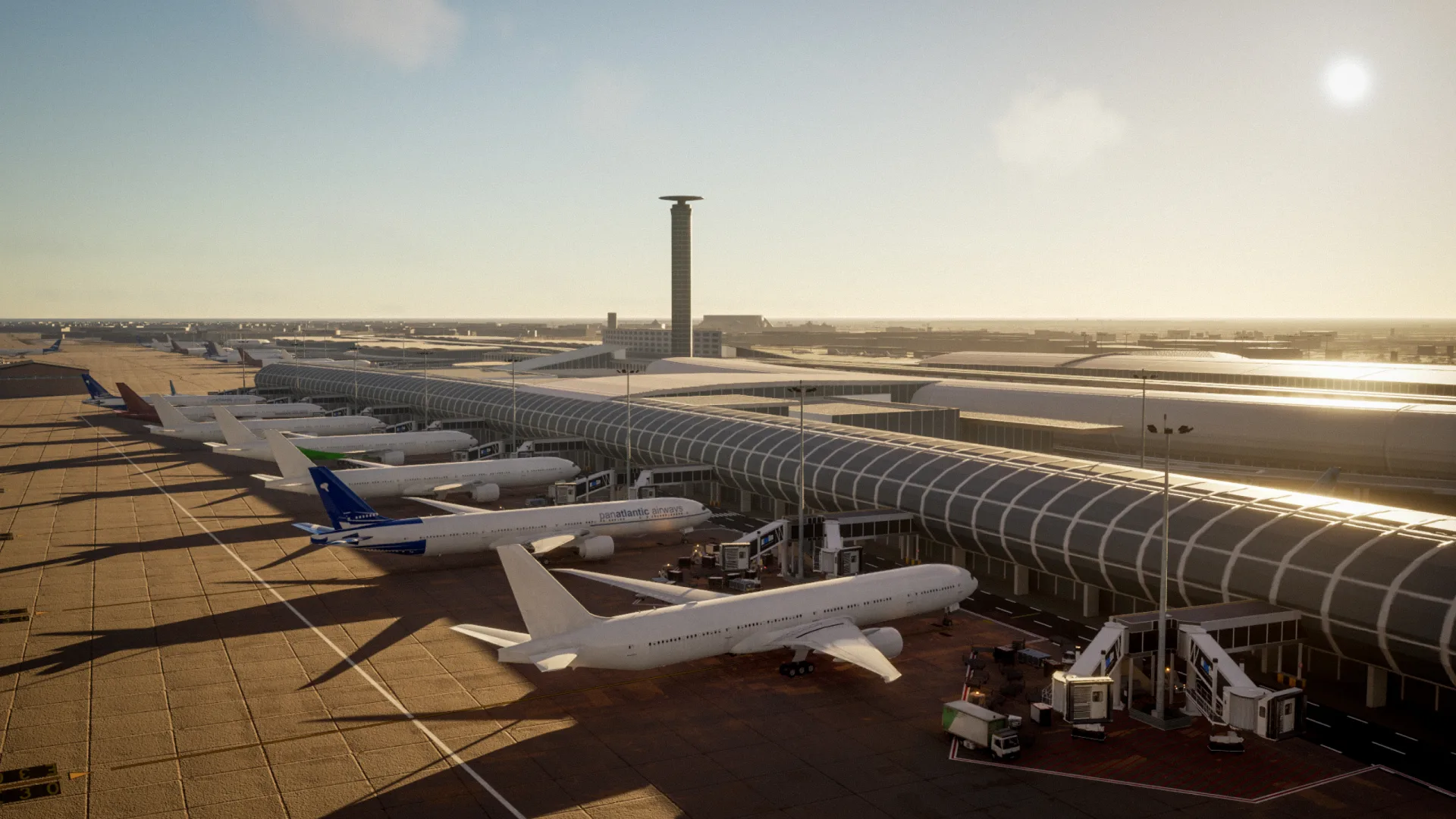
A procedurally generated airport in AILiveSim
What a Procedural Airport Actually Is
Start with the name, because it trips people up. The term procedural airport describes a concept, not a single product. The tooling behind it includes Geo Referenced Data, the plugin that procedurally generates airports and other landscapes, and Airport Assets, which provides the ground vehicles and the rest of the furniture.
Together they let a user define the layout of an airport and have the platform build a three-dimensional scene from that two-dimensional description. Procedural is the operative word: the scene comes from a set of rules and references, not from someone placing every object by hand.
Recreating Real Airports as Digital Twins
A procedural airport is not limited to layouts you dream up. Working from real reference data, the platform can reproduce an airport that already exists:
- Starting from two-dimensional reference data of a real airport, the platform generates a matching three-dimensional landscape.
- That landscape is a digital twin of the actual airport, not a generic stand-in.
- Because the reference does the heavy lifting, building it stays quick and easy.
An existing airport can move from a flat map to a full 3D environment that is ready to use, without anyone rebuilding it piece by piece.
Simulate Any of the World’s Thousands of Airports
The bigger idea is coverage. Once any airport can be generated from a reference, you stop rehearsing against the same two or three environments. Any airport becomes a playground for producing synthetic data or testing AI.
Look at how real flights spread out: in one past project, an aircraft manufacturer flew to roughly 3,000 airports, with about half of its flights landing at 1,000 of them and 80% at around 300.
A perception system that only ever trains on a handful of those is unprepared for the rest. Being able to simulate any of the world’s thousands of airports closes that gap and gives much better coverage of wherever the aircraft actually flies.
From a 2D Shape File to a 3D Landscape at Runtime
The process starts with a shape file, a two-dimensional vector map that lays out the airport. From there the build is straightforward:
- The user labels each area of the map: this zone is a building, this one a runway, this one a parking lot.
- At runtime, the platform spawns three-dimensional objects into those zones, turning each labeled area into what it represents.
- Because the scene is generated from those definitions rather than placed by hand, it is procedural in the true sense.
A flat outline goes in, and a full three-dimensional airport comes out the other side.
Control Over Every Parameter, Not a Fixed Level
Generating the scene is only half the story. Because everything is procedural, the result is not a fixed level you are stuck with. You can open the settings and adjust the parameters that decide how the airport looks and behaves.
Ground coverage is one of them. Runway markings are another, down to how crisp or faded the lines appear.
That kind of control adds flexibility for whatever use case you have in mind. Instead of one frozen environment, you end up with one you can keep reshaping, which beats taking a prebuilt level and using it exactly as it shipped.
Speed, Scale, and Control: The Customer Payoff
Put it together and the value is easy to see. Building a single airport by hand used to take months. With this approach, generating new ones is far faster, and the work moves into the customer’s own hands.
Need three airports? Three thousand? You can produce as many as you have reference data for, at no extra cost from AILiveSim.
On top of the speed and the scale, you keep the control to adjust each environment instead of accepting whatever was handed to you. For teams building autonomy and perception for aviation, that mix of any airport, generated fast and fully adjustable, is hard to find anywhere else.
Conclusion
The hardest part of simulating airports has always been building them.
The procedural approach turns that around: hand the platform a two-dimensional reference and it produces a three-dimensional digital twin you can shape to your needs. With AILiveSim, any of the world’s thousands of airports becomes available for synthetic data and AI testing, on your terms and at the speed your development needs. When the next airport matters, you will not be waiting months to model it.
Resources
Explore Our Latest Insights
Stay informed with our expert articles and updates.
Article
Have You Tested Enough? Intelligent System Testing and the Coverage Problem
Test volume measures effort, not proof. How Intelligent System Testing samples scenarios adaptively to map where an autonomous system works, where it fails, and which combination of conditions moves it from one to the other.
AILiveSim
August 22, 2026 • 4 min read
Article
Swarm Defense Testing: Measuring Intercepts, Not Detections
Why no volume of captured data validates swarm defense: adversarial scenarios generated live around the system under test, scored as intercepts achieved versus hits on the protected vessel across repeatable, parameterizable waves.
AILiveSim
August 17, 2026 • 4 min read
Article
Counter-Drone Detection: Why Precision Fails Before Recall Does
Why counter-drone detection fails on precision before recall: negative-class coverage by sensor channel, and scoring threats neutralized alongside friendlies preserved on repeatable, configurable drone waves.
AILiveSim
August 13, 2026 • 4 min read
Article
What Has to Be Inside an Airport Digital Twin Before It Is Worth Anything
What an airport digital twin must contain before it is worth anything: rare surface conditions, four time-aligned sensors, automatic labelling, and procedural generation that extends to your airport.
AILiveSim
August 10, 2026 • 4 min read

Discover the benefits of synthetic data and simulation
By navigating on this site you agree that we use only minimal cookies required for this site to function. We do not monetize your data.